Decoding Strategy. Recoding How Your Organisation Works.
Strategy is only as good as the system that delivers it. WORKCODES designs practical target operating models, agile structures, and AI-enabled workflows that turn executive ambition into friction-free operational reality.
Our Service Portfolio
Operating Model Design
An effective operating model translates business strategy into a clear execution blueprint. We work alongside executive leadership to design, refine, and operationalise robust operating models tailored to evolving market demands.
Our Approach & Value Delivery
Value Chain & Capability Mapping: We evaluate your business model to identify core capabilities, define where value is created, and determine how to group and prioritise resources.
Governance & Decision Architecture: We establish clear governance frameworks, defining decision rights, steering structures, and authority matrices to eliminate bottlenecks and accelerate execution.
Process & Technology Alignment: We map key end-to-end operational workflows, ensuring business processes, technology enablement, and data flows directly support corporate goals.
Location & Sourcing Strategy: We help determine optimal service delivery models—balancing onshore, nearshore, shared service centres, and third-party partner ecosystems.
Organisation Design
Structure should always follow strategy. Our designs are scalable, fit-for-purpose organisational structures that eliminate friction, clarify accountabilities, and drive cross-functional collaboration.
Our Approach & Value Delivery
Structural Architecture & Macro Design: We help organisations transition from legacy siloes to agile, matrixed, or product-centric structures that improve speed to market.
Role Profiling & Micro Design: We design detailed role definitions, reporting lines, span-of-control targets, and accountability frameworks (e.g., RACI) to remove ambiguity and operational overlaps.
Workforce Sizing & Efficiency: We evaluate workload drivers, management layers, and team dynamics to optimise operational spans and drive cost efficiency without sacrificing delivery capacity.
Change & Cultural Alignment: We integrate change management principles into the structural design phase, ensuring smooth transitions, stakeholder buy-in, and minimised business disruption.
Strategic Workforce Planning
A strategy is only as achievable as the talent pipeline supporting it. We provide data-driven Strategic Workforce Planning frameworks that ensure you have the right skills, in the right places, at the right time, and at the right cost.
Our Approach & Value Delivery
Supply & Demand Forecasting: We build quantitative baseline models of your current workforce while modelling future talent demand across multiple business growth scenarios.
Critical Skill & Gap Analysis: We identify high-risk skill shortages, emerging capability needs, and demographic risks (e.g., retirement exposure, attrition trends) across critical business functions.
The "6Bs" Talent Strategy: We construct targeted interventions across Build (upskilling), Buy (recruitment), Borrow (contract/consulting), Bounce (redeployment/outplacement), Bind (retention), and Bot (automation/AI).
Workforce Analytics & Governance: We embed ongoing SWP capabilities within your internal HR and leadership teams, providing dashboards, tracking tools, and review cadences to maintain long-term workforce agility.
Latest News

Advancing the Art and Science of People Management: Stepping into the Co-Chair & Council Representative Role for CIPD Central London
Stepping into the role of Co-Chair of the CIPD Central London Branch is both a privilege and an exciting new chapter in my commitment to our profession. At the heart of this work lies the CIPD’s chartered purpose: "To promote and develop the Art and Science of people management for the public benefit."
Local branches are among the most valued benefits of CIPD membership, powered by a dedicated community of around 650 branch volunteers working alongside approximately 350 CIPD staff members. Leading the Central London branch alongside my fellow Co-Chair means stewarding a vibrant network of organisations and practitioners, championing inclusion and belonging, and ensuring our local community receives practical, high-impact professional value.
As a Chartered Fellow Member and Branch Co-Chair, my primary responsibility is to lead the Central London branch in line with our local branch plan and the overarching CIPD strategy. Rather than functioning as a commercial platform, our branch exists solely to deliver member value, uphold CIPD ethics, and foster genuine peer-to-peer learning.
Photo: Michelle Pilkington, WORKCODES Director

Redefining Work: The Impact of AI on Operations, the Workforce, and HR Management
Artificial intelligence is no longer merely a technological upgrade; it is a fundamental catalyst reshaping organisational design. Across company operations, AI is shifting business models from reactive administration to predictive execution. By automating routine workflows and synthesising complex operational data in real time, organisations are streamlining core processes, accelerating decision-making, and unlocking significant productivity gains.
For the workforce, this operational shift moves the focus from static job titles to dynamic skills. Rather than simply replacing human capability, AI is restructuring work itself by automating repetitive tasks while elevating the value of human judgment, creativity, and emotional intelligence. Navigating this transition demands continuous reskilling, psychological safety, and transparent change leadership to sustain employee trust and engagement.
Nowhere is this transformation more pivotal than in HR management. Freed from high-volume administrative transactions, people professionals can focus on strategic workforce planning, talent architecture, and organisational effectiveness. From skills-based recruitment and personalised learning pathways to predictive retention analytics, AI empowers HR to align human potential directly with business strategy. Ultimately, successful AI integration is not merely a technology deployment; it is a human-centric transformation requiring ethical governance, purposeful work redesign, and empathetic leadership.
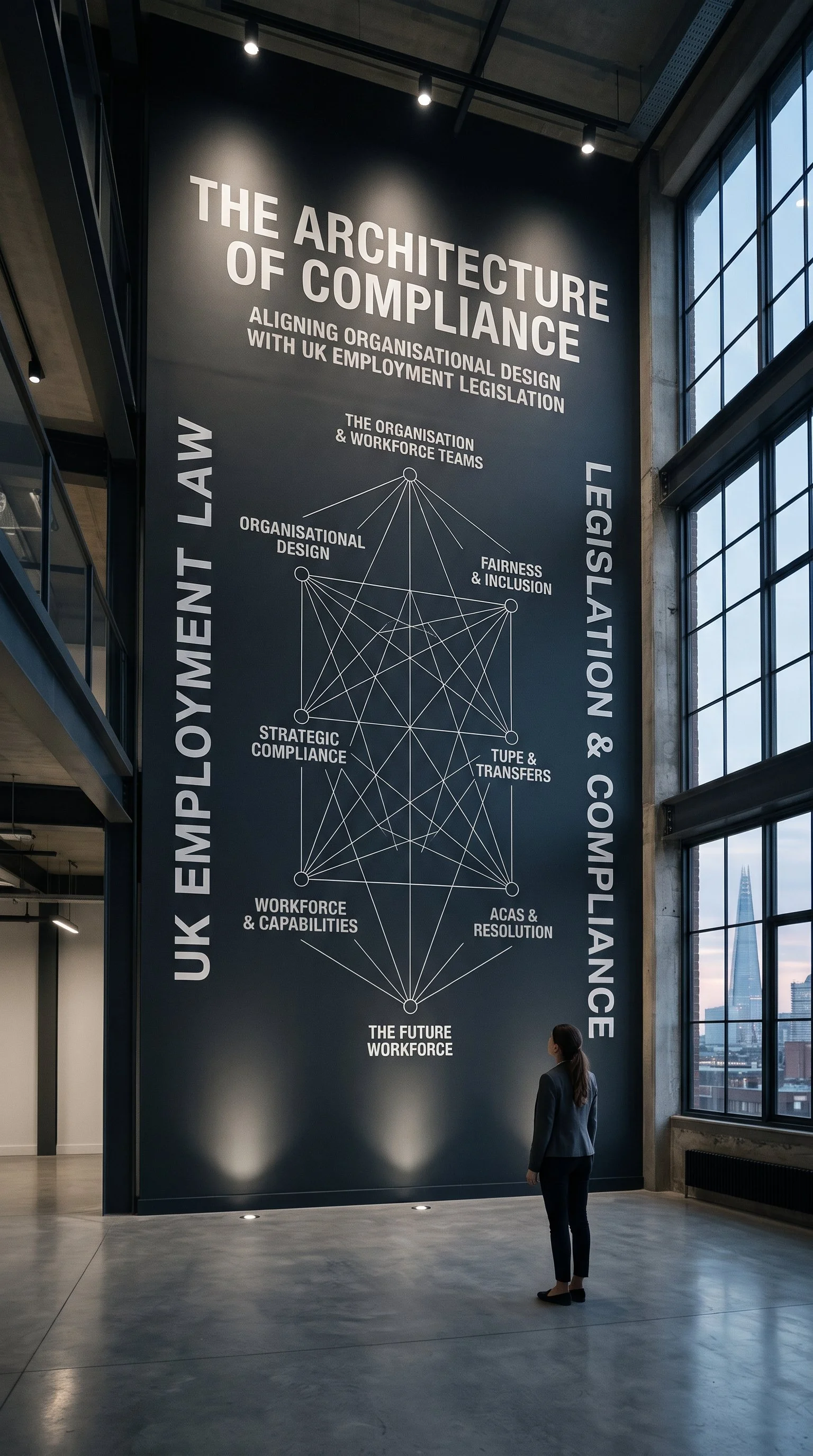
Navigating the UK’s Statutory Employment Reform (2025–2029)
The UK workplace regulation framework is undergoing its most significant structural evolution in a generation. Driven by the Employment Rights Act 2025, the Data (Use and Access) Act 2025, and expanded immigration legislation, businesses face a permanent shift toward codified day-one rights, heightened transparency, and active state enforcement.
Key operational shifts active in 2026 include day-one Statutory Sick Pay, day-one paternity leave, doubled Employment Tribunal limitation periods (extended from three to six months), and strict accountability for AI-driven hiring tools under the Information Commission. At the same time, state enforcement has intensified with the launch of the Fair Work Agency (FWA) and £60,000 civil penalties for supply-chain Right to Work non-compliance.
Looking ahead, 2027 marks a critical horizon. On 1 January 2027, the ordinary unfair dismissal qualifying service drops from two years to six months alongside the complete removal of the statutory compensation cap. Subsequent reforms—including restrictions on "fire and rehire," entity-wide collective redundancy triggers, mandatory equality action plans, and upcoming ethnicity and disability pay gap reporting—require immediate organisational agility.
To insulate against uncapped litigation and state penalties, corporate leaders must professionalise probationary reviews before Month 5, audit holiday pay records, and lock down supply-chain compliance protocols today.